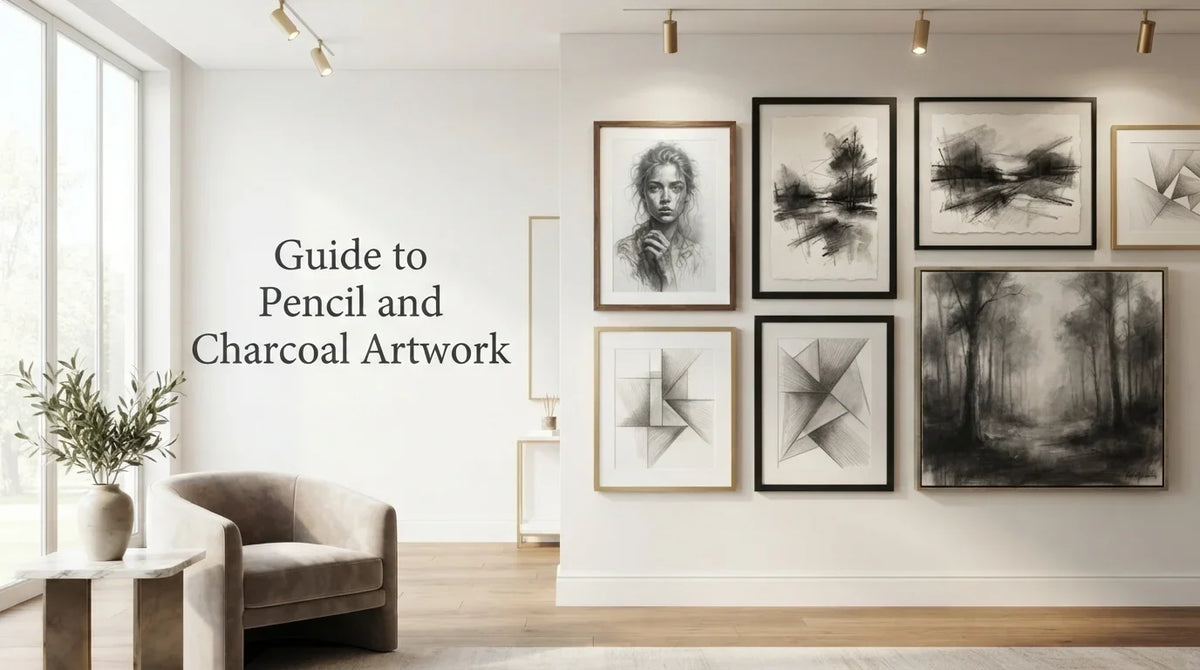
There is something quietly powerful about a drawing made with only graphite or burned wood. Fine charcoal artwork and detailed pencil pieces are expected to demand a room’s attention in silence. But finding the right medium, surface and framing style can be confusing for buyers who just want a piece that fits their space and will last for years to come. This guide walks you through the major styles, materials and display options, so you can buy, care for and frame your art with complete confidence.
What Is Charcoal Artwork?
Charcoal has been used by artists for thousands of years and is still one of the most expressive media for drawing available today. Knowing what makes this style special allows buyers to appreciate the craft behind each piece.
Charcoal Art Definition
Charcoal art is a drawing medium that uses charred wood or compressed charcoal sticks on paper or canvas. The medium gives us deep blacks, soft grays and smoky textures a pencil alone cannot. Artists use it for everything from quick figure studies to full-blown gallery work.
Charcoal sits loosely on the surface so you can create dramatic smudging and blending effects. This provides the finished piece with a raw, tactile quality many collectors find more engaging than a polished painting. It is this rawness that keeps charcoal popular with serious art buyers.
How Charcoal Painting Differs From Charcoal Art
Charcoal art and charcoal painting are often used together, but there is a small difference between the two that is worth understanding. Charcoal art is a broad term for all art made with charcoal from quick sketches to finished works. Charcoal painting is usually a more developed, layered piece for display, not study.
A charcoal drawing will generally take several sessions to complete the shading, blending and highlights. The artist develops the tone as a painter develops color. Often the price and presentation of the finished piece reflect this extra time and technique.
What Gives Charcoal Its Rich Tonal Depth?
The range of tones in charcoal is produced by the way the medium interacts with the tone or texture of the paper or canvas. Surfaces that are rougher and hold more pigment will make darker, richer blacks. Smoother surfaces give softer, standard gradients which give themselves to portrait work.
This range is used by skilled artists to create depth and dimension that is almost sculptural in nature. Shadows seem to recede and highlights to jump right off the page. This guide of charcoal paintings goes into detail about the technique artists use to create emotional impact with contrast and depth.
What Is Pencil Artwork?
Pencil is still one of the most accessible yet difficult media in fine art. It's precision results in an extraordinary amount of detail, and for this reason so many collectors seek out pencil artwork for their homes and offices.
Understanding Pencil Art Drawing Techniques
Pencil art drawing is the layering of graphite with hatching, cross hatching, and blending with a stump or tissue. Each technique yields a different texture and tonal effect. Hatching creates visible line work that adds energy to a piece. Blending softens transitions for a more photographic look.
Often an artist will use a combination of techniques in one drawing to achieve fine detail as well as smooth shading. This combination is part of what separates amateur sketches from professional-grade work. The best pencil artists know exactly when to use which technique.
What Makes a Good Pencil Sketch Art Piece?
Strong pencil sketch art walks the line between correct proportions and confident, purposeful line work. A good sketch does not need to be completely rendered to be complete. Suggestion and negative space can be as heavy as detail.
Collectors often look for pieces that have a strong focus and a sense of movement, even if the subject is static. A rough sketch can be more natural and more emotionally direct than a finished piece. Many buyers actually prefer this more relaxed, more energetic style for casual living spaces.
Popular Styles Within Pencil Artwork
Pencil artists work in a wide variety of styles and that is a part of what makes this medium so appealing. Some focus on tight realism while others explore looser, more expressive mark making.
- Realism of fine detail, often used for portraits and wildlife subjects
- Loose gesture drawing, for figure studies and quick studies
- Architectural and technical drawing, used often for buildings and interiors
- Illustrative styles based on comic art and design work
- Mixed tonal work with graphite and charcoal accents
Each style has its own emotional tone and visual story. This guide to pencil art goes into more depth about the concepts if you want to explore how artists use symbolism, choice of subject and composition to tell a deeper story through their work.
Exploring Different Styles of Pencil and Charcoal Art
Both mediums have many artistic directions beside the basic techniques. Understanding these categories helps buyers to choose a piece for their space.
Realistic and Portrait-Focused Styles
Realism remains one of the most requested styles among collectors, especially for family portraits and pet commissions. This method requires exact proportions, careful shading and attention to the light source. A good realistic drawing can look almost like a photo from a distance.
Portrait pencil art demands an extraordinary level of patience, as any minor mistakes in facial proportion become instantly noticeable. Artists working in this style spend many hours perfecting individual features like eyes, hair texture, etc. If you’re a buyer looking for a custom portrait, this resource on portrait pencil art explains what to expect from the process of commissioning a portrait.
Abstract and Contemporary Styles
Not all buyers want a literal representation of a subject. Modern homes and offices are being furnished by clients who have taken to abstract charcoal and pencil work, as it goes well with minimalist interiors.
Abstract pencil art is about shape, texture and movement, not about recognizable subjects. This style gives buyers more flexibility to match a piece to the existing color scheme and furniture in a room. For design inspiration and trends in this space, have a look at this feature on abstract pencil art for modern interiors.
What Is the Best Pencil Art for Home Display?
The best pencil art for your home will depend on the lighting, size of the wall and the overall mood you want to create in the room. There are some practical considerations that may help to guide this decision.
- Select larger, bolder pieces for open living rooms with high ceilings
- Go for smaller, detailed pieces for hallways and reading nooks
- Match subject matter with the function of the room, such as calming scenes for bedrooms
- Watch out for wall color, light graphite can disappear against pale walls
- Consider the natural light exposure for the artwork to make sure of its value
When these details are taken into account, this helps to make sure that the piece feels intentional, not accidental, in the space.
Pencil Art Painting vs Pencil Art Work: Understanding the Difference
Buyers often see both terms while shopping and wonder if they are the same. But there is a meaningful difference to clarify here.
Is Pencil Art Considered a Painting Technique?
Technically, pencil art painting is a bit of a misnomer, as pencil is a drawing medium and not a paint medium. But the term is also often used to describe highly rendered pencil pieces that achieve a painterly depth and realism. These works often have the same visual weight as a traditional painting.
The confusion is primarily in the marketing, not in the technical accuracy. Buyers care most about the finished visual result, not in which strict category the piece falls. A good pencil piece can hold a wall just as good as an oil painting.
Common Applications of Pencil Art Work in Galleries
Pencil art work is represented in all types of gallery settings from small boutique shows to more expansive group shows. Often, galleries will include pencil works with paintings to show the differences between mediums.
This combination allows buyers to appreciate that graphite work can hold its own against color-based pieces. Most collectors begin with pencil art because it is generally less expensive than large oil paintings. It also presents itself more muted in a gallery-type space.
Charcoal and Pencil Mediums: Paper vs Canvas
The surface you choose will affect everything from the final look of a piece to how it will need to be maintained over time. This decision deserves careful thought before any purchase.
Working on Canvas Surfaces
Canvas provides a tougher, more textured surface than traditional paper. Most artists now stretch canvas especially for charcoal and pencil work as it allows for larger scale pieces without the fragility of paper. This makes canvas a good choice for feature walls and larger rooms.
Charcoal painting on canvas also has the ability to take pigment differently than paper, often producing a deeper, more sharp contrast. And it’s also easier to frame, because canvas is more resistant to tearing and easier to mount without additional backing. This guide to charcoal painting on canvas gives buyers the information needed for a complete breakdown of canvas vs paper for cost, durability and preservation.
Does Canvas Last Longer Than Paper for Charcoal Art?
In general, canvas is a more durable support than paper in the long term, especially for larger works. Paper is more likely to crease, yellow and tear over time, if not properly framed and protected.
That said, paper pieces can last decades when properly framed, including acid-free matting and UV-protective glass. And the real difference is not just the surface of the piece but how it is handled and displayed after purchase.
Pencil Painting on Specialty Surfaces
Some artists experiment with pencil painting on toned paper, wood panels or mixed media board. Artists use toned paper as a middle ground from which to build highlights and shadows for a more serious three-dimensional effect.
These specialty surfaces often produce more unique, rare results than regular white paper. Those buyers with an interest in unusual textures may find these pieces more visually interesting in a curated art collection.
Choosing and Caring for Charcoal Artwork and Pencil Artwork
Owning fine art comes with a responsibility to care for that art. A few simple habits can add years to the life of any piece.
How Do You Preserve Charcoal Artwork From Smudging?
Charcoal is particularly affected by smudging because the pigment sits loose on the surface. Most professional pieces have a fixative spray applied over the piece once it is finished to lock the particles in place. Before framing or handling any piece, this is a needed step.
Add good glass framing, in addition to fixing, and you have another layer of protection from accidental contact and airborne dust. Don’t touch the surface directly and keep it out of direct sunlight so it doesn’t fade over time.
What Should You Look for When Buying Original Art?
Buying original pencil or charcoal art is an investment, a little research goes a long way. Keep these in mind before buying.
- Check the artist’s background and previous body of work
- Inspect quality of materials used (Paper weight or canvas grade)
- Make sure the item has a signature or certificate of authenticity
- Consider the size to fit the place where you are planning to hang it
- Ask about framing options included with purchase
These steps help avoid buyer disappointment and make sure the piece will hold its value over time.
Custom Framing for Pencil and Charcoal Artwork
A right frame is more than a protection for a drawing. It influences the way the entire piece appears in a room.
Why Custom Framing Matters for Fine Art Drawings
It is rare that standard off the shelf frames is the right scale or tone to match fine pencil and charcoal work. In these media, UV-protective glass is especially important, as both graphite and charcoal are prone to fading under extended light exposure. Matting also has a functional purpose, keeping the artwork from touching the glass directly.
The mounting process for works on canvas is entirely different and usually involves a special backing and a stretcher bar. It takes experience to do this process right, so many collectors look for professionals instead of trying to do it themselves.
Gallery-Grade Presentation Options
When you work with a specialist, each piece is given the presentation it deserves, from the color of the mat to the finish of the frame. Expert Framing Art Gallery’s team works closely with collectors to match the framing choices are in keeping with the artwork and the room to which it will hang. This kind of tailored approach helps preserve the piece while giving it a genuinely gallery-grade finish.
The right framing partner also gives access to archival materials so the artwork is protected over time. This is especially important for original pieces that cannot be replaced if they are damaged.
Frequently Asked Questions
Q. What is the difference between charcoal art and pencil art?
Charcoal art uses dark wood or compressed sticks that give strong smoky tones. Pencil art uses graphite for a finer more controlled detail. Charcoal is often used to make higher contrast, pencil allows more precision on fine lines and light shading.
Q. Is charcoal artwork more expensive than pencil artwork?
The price is more dependent on the artist, size and complexity than the medium. Now this can make the price of a piece of charcoal artwork with a lot of detail, a little higher. But detailed pencil work is often just as expensive.
Q. What is charcoal art definition in simple terms?
Charcoal art is any drawing done using charcoal sticks or other charred material on paper or canvas. It’s also famous for the ability to create dark blacks, soft grays and expressive smudged textures that are difficult to achieve with other drawing media.
Q. Can pencil sketch art be framed like a painting?
Yes, pencil sketch art can be framed like a painting as long as it's got UV-protective glass and acid-free matting. Proper framing keeps the graphite from smudging and fading and gives the piece a polished, gallery-ready presentation.
Q. What surface works best for charcoal painting?
Textured paper or primed canvas is best for charcoal painting, as the more rough the surface, the better it will hold the pigment. The choice depends on the size and durability you want, with canvas being more popular for larger statement pieces.
Q. How do you clean or maintain pencil artwork?
Do not touch the surface directly and keep the piece away from direct sunlight to prevent fading. Gently dust the outside of the frame with a dry cloth, but never try to remove the artwork itself without professional advice.
Q. Is charcoal painting on canvas more durable than on paper?
Generally, yes. Charcoal painting on canvas is more resistant to tearing and creasing than paper, which makes them a more durable choice for display in large-scale or high-traffic areas. Surface is not important for long-term preservation, but correct framing still is.
Q. What makes portrait pencil art different from realism sketches?
Portrait pencil art is specifically concerned with the correct proportion and expression of a person’s likeness. Realism sketches can be of more general subjects such as landscapes or objects, while portraits demand exact attention to facial detail and emotion.
Q. How do you choose the best pencil art for a living room?
Consider the scale of the room, lighting and existing color palette when selecting the best pencil art for the living room. Open spaces are best for larger bolder works and cozy reading corners or hallway walls are best for smaller detailed works.
Q. What is abstract pencil art and how is it styled?
Abstract pencil art targets the shape, texture, and movement, not recognizable objects. It is ideal for modern and minimalist interiors, as it can be combined with existing color schemes in a flexible way without showing a literal scene or object.
Q. Can charcoal paintings fade over time?
Yes, but charcoal paintings can smudge or come off if not properly framed and fixed. UV-protective glass and a quality fixative spray will effectively minimize this risk, allowing the piece to maintain its depth and contrast for many years to come.
Q. Is pencil art painting a recognized fine art category?
Pencil art painting, technically a drawing rather than a painting, is a form of fine art widely respected for its painterly depth and realism. Many galleries show these works along side traditional paintings without distinction.
Q. How should custom framing be selected for charcoal art?
Select glass that will protect against UV light, acid-free matting, and a frame finish that will complement the existing decor of the room. A professional, like Expert Framing Art Gallery, will not only help to protect the piece but also improve the overall presentation.
Q. What size pencil artwork works best for gallery walls?
For gallery walls, the most balanced look is usually a combination of a few larger anchor pieces and smaller supporting works. The right sizing depends on the dimensions of the wall, the spacing between pieces and the overall visual rhythm you want to achieve.
Final Thoughts
Pencil and charcoal are still the most expressive mediums in fine art and have a depth, texture and emotion that few other styles can match. From the smoky richness of charcoal artwork to the fine precision of detailed pencil drawings, both mediums add real character to any collection or living space.
Selecting the right piece means looking beyond aesthetics alone. Surface, size and framing all contribute to how a piece looks and how long it will last. Working with experienced professionals for custom framing helps protect your investment while giving it the presentation it deserves.
Whether you prefer bold abstracts or highly rendered portraits, there is a work in this medium to suit your space and taste. Fine pencil and charcoal artwork can be a meaningful part of your home for generations with the right care and framing.
Share:
Charcoal Painting on Canvas vs Pencil: Mediums & Framing