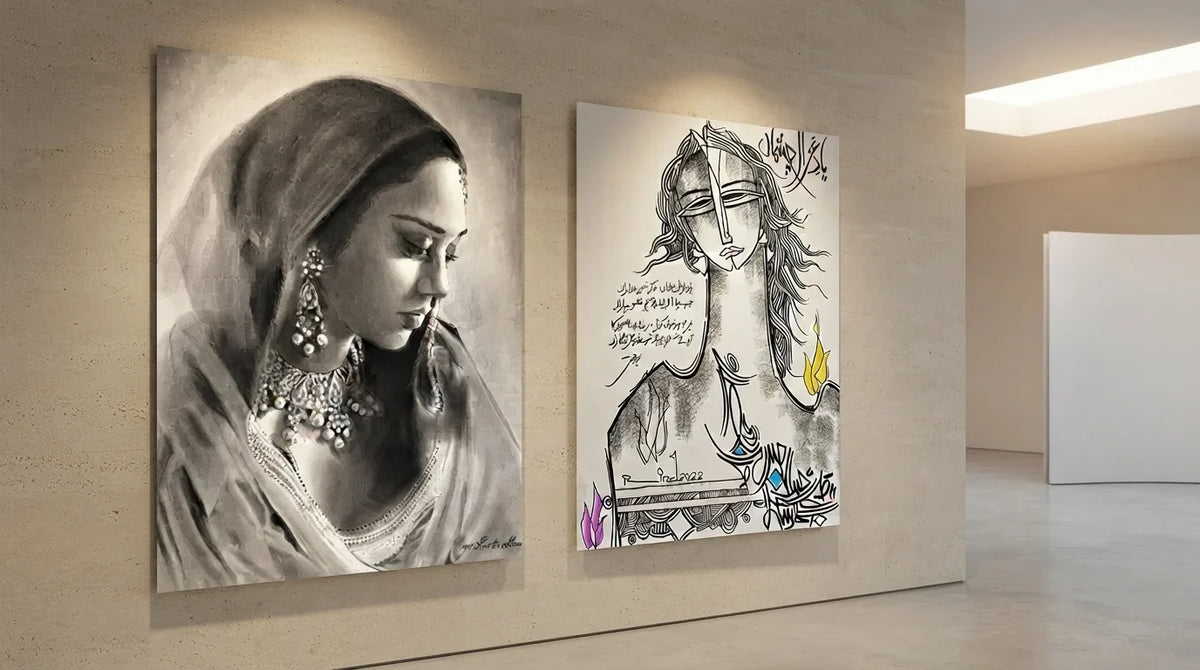
Charcoal and pencil are both foundational drawing media, but they work entirely differently on a surface, and they yield visually and physically different results. Often collectors and buyers think they are similar, or that the difference is just a matter of shade and fashion. That's really a further difference than that. A charcoal painting on canvas makes a different kind of mark, a different surface character, a different visual presence in a room than a pencil-based work. Knowing the differences is important if you are choosing art for a specific interior, commissioning a piece or figuring out how to frame and protect what you already have.
Charcoal Painting on Canvas: Texture and Depth
The surface character achieved by charcoal painting on canvas is not the same as that of paper based charcoal work. Canvas has a rougher tooth than most drawing papers and that grain does something to charcoal. The particles of charcoal are caught in the weave of the canvas, and they make marks that feel attached, rather than sitting on top of a flat surface. This imparts a physical presence and tonal depth to the finished work that is immediately apparent when you see it.
The tonal contrast possible on canvas is also much greater than on paper. The canvas grain has a higher density of charcoal so that artists can push into deep, dark blacks that paper often resists after a certain point. Coupled with the lighter values where the texture of the canvas breaks the charcoal deposit, the result is a range of contrast that gives charcoal canvas pieces a raw, expressive finish. The marks feel bold and confident, in a way that’s right for large scale, statement making compositions.
One good point is the effect of canvas tooth on blending. Charcoal can be mixed on smooth paper to very even, continuous tonal gradations. On canvas, that smoothness is broken by the texture, giving a slightly broken blend that actually reads as more atmospheric and textured when viewed from any distance. This is not a limitation of the medium itself. This is one of the things that makes charcoal on canvas so different from any other drawing surface.
Understanding Charcoal Pencil Art and Charcoal Sketch Art
Charcoal pencil art is a different position than broad charcoal stick art. Charcoal pencils are compressed charcoal in a pencil casing, which gives the artist a lot more control over line weight and placement than loose sticks do. The result is work that is something between the expressive nature of traditional charcoal sketch art and the precise control of graphite pencil drawing.
Charcoal pencil drawing allows artists to work with greater definition, achieving fine lines and controlled edges that would be difficult with charcoal sticks. Charcoal pencil sketch work is especially helpful for subjects that require both the tonal depth of charcoal and the detail of pencil work, such as animal portraits, architectural subjects or figurative work where both broad shadow areas and fine surface details are required in the same piece.
Key traits of charcoal pencil work:
- More control over line weight and placement of marks than traditional charcoal sticks offer
- Sharper edges with better definition during the working process
- Great for smaller detailed compositions where you want detail and tonal depth
- More easily layered tone without the heavy smudging that loose charcoal creates all over the surface
How Pencil Shading Art Builds Realism
Pencil shading art works on an altogether different logic to broad atmospheric marks of charcoal. Where charcoal builds tone by the density of pigment deposit and pencil shading builds tone by accumulated layers of controlled lines at varying pressures. The result is a surface that looks built, rather than painted, and that quality reads very differently to the viewer.
Pencil painting art in the realist tradition uses this layering approach to achieve an almost natural transition between light and dark when done well. The detail of the marks and the slow build-up of layers give the artist a certain amount of tonal control that charcoal not often allows. Pencil work is more subtle and precise in midtones especially. In charcoal, the midtones might feel a little more rough, because of the texture of the smudging.
There are some subjects that are better created in pencil than in charcoal. The precision of layered pencil shading works better for rendering things like skin tone gradation, the slight change in fur texture from one part of an animal’s coat to another, or the gentle shift in tone across a curved ceramic surface, than the bolder approach of charcoal. The medium suits subjects where the viewer is expected to look closely and discover the detail rather than receive a strong visual impression from across the room.
Colored Pencil Art and Pencil Colour Painting as an Alternative
The warmth and tone of colored pencil art is not so intense as paint, nor so stark as graphite or charcoal. The medium uses pigment in the same layering logic as pencil shading, but the color relationships add a dimension that monochromatic media cannot provide. When carefully layered with different hues across a surface, pencil colour painting can achieve great depth and luminosity.
Colored pencil artwork attracts buyers who want the refined, handcrafted quality of pencil work and the visual warmth of colour. The finished result has a softer, more personal feel than paint, with a slightly textured surface quality that is different from both oil and acrylic work. If the aim of an interior is strong colour, but bold painted surfaces seem too dominant, then the use of coloured pencil work provides a truly useful middle ground, which allows the depth of drawing to be maintained but with chromatic range added.
Charcoal Painting vs Pencil Art: Key Differences
Graphite pencil work and charcoal pencil painting produce different results that directly influence presentation and room context. The following comparison highlights the most meaningful differences:
- Charcoal has deeper contrast and bolder tonal range, whereas pencil has finer precision and gradual gradation
- Charcoal is for bold, expressive statement pieces where the priority is strong visual presence from a distance
- Pencil suits detailed, intimate compositions where the reward is in close viewing and discovered detail
- Charcoal is more easily faded, so careful handling and protection fixes are needed before framing
- Charcoal reads clearly and powerfully from several metres away while pencil rewards viewers standing at arm’s length
- Charcoal gives a raw atmospheric quality, pencil gives a controlled refined surface character
The practical value for buyers is simple. Charcoal canvas pieces look great on large walls in living rooms, hallways and statement spaces where the artwork needs to carry visual authority across a room. Pencil work works well on smaller walls, personal spaces and rooms where the viewer naturally spends time close to the work of art such as studies, reading corners and bedrooms.
Which Medium Holds Up Better Over Time, Charcoal or Pencil?
Both can last generations when properly fixed, framed and glazed. Charcoal is more prone to smudging and needs fixing spray before framing and UV-protective glass once displayed. Pencil is more stable by nature, but still responds well to acid-free matting and archival framing. Neither medium fades much if not exposed to direct sunlight and excessive humidity.
Framing Considerations for Charcoal and Pencil Artwork
Protection glass of charcoal pieces is a required step, not an optional finishing touch. Charcoal that is not fixed or only lightly fixed may still shed and smudge if the glass is in direct contact with the surface. A mat board is necessary between the work and the glass, and the glass should be museum-quality UV glass to provide another level of protection against the light exposure that any exhibited work is subject to over time. If these precautions are not taken, a piece of charcoal could get worse significant in a few years of display.
Pencil work requires different but just as specific framing. The paper surface is subject to acid migration from non-archival framing materials which may cause yellowing and surface degradation over time. Fine pencil shading requires acid-free mat boards and archival backing materials to maintain the clarity and delicacy of the work. Like charcoal, pencil drawings benefit from a UV-protection glaze, because even ambient light can slowly affect the whiteness of the paper surface that gives pencil drawings their tonal range.
Expert Framing Art Gallery are experts in framing for specifically these types of delicate works. They provide suitable glazing, archival materials and mat board options that will preserve both charcoal and pencil pieces for long term display without compromising the visual quality of the artwork itself.
Key Takeaways
Charcoal painting on canvas and pencil art are not just different forms of the same medium. They are different media, with different physical properties, different visual results, different display and framing requirements. Charcoal provides bold tonal contrast, atmospheric depth and a strong visual presence, ideal for statement walls and expressive compositions. Pencil work provides accurate gradation, refined surface detail and close visual quality appropriate to close viewing and peaceful interior contexts.
The decision should depend on how the room is to be used, how close the viewers are likely to be to the art, and what kind of visual experience the space demands. It is in understanding these factors and being sure the piece selected is properly framed for long-term preservation that a thoughtful art decision is distinguished from a purely natural one.
Frequently Asked Questions
Q. What Is the Difference Between Charcoal Painting on Canvas and Pencil Art?
Charcoal painting on canvas means compressed or stick charcoal applied to canvas. It creates bold tonal contrast, rich blacks and an expressive, atmospheric surface. This is a pencil art technique where graphite is applied in controlled layers to achieve finer gradation, a higher precision of detail, and a quieter visual quality suitable for close viewing distances.
Q. Is Charcoal Pencil Art Different From Traditional Charcoal Painting?
Yes. Charcoal pencil art is made with a compressed charcoal pencil case, which gives you more control and cleaner edges and more detailed marks than loose charcoal sticks. Traditional charcoal painting has broad marks, more smudging, and a looser, more expressive visual language that matches it to larger formats and more bold compositions.
Q. Which Medium Holds Up Better Over Time, Charcoal or Pencil?
Proper care makes both durable. Charcoal needs a fixative before framing and a protective glaze to prevent smudging and dust accumulation. The pencil is a bit more stable, but requires acid-free matting and archival backing to prevent yellowing. Neither medium is much affected by age if kept away from direct sunlight and moisture.
Q. Can Colored Pencil Art Achieve the Same Depth as Charcoal?
In colored pencil art, depth is achieved by building up relationships of colour on top of tonal contrast of charcoal. It can be quite visually rich with the right subject, but the kind of deep, atmospheric darkness that charcoal makes with bold mark-making and strong tonal contrast is not something a colored pencil naturally replicates.
Q. Why Does Charcoal Painting Need Glazing When Framed?
Charcoal painting on canvas requires to be varnished because the charcoal particles remain loose on the surface even after the application of fixative. Without glass, the surface will smudge and deteriorate over time from dust and physical contact. A matboard separates the artwork and the glass to keep them from touching and allows the piece to be displayed safely long term.
Q. What Makes Pencil Shading Art Suitable for Detailed Portraits?
Pencil shading art creates tone by applying layers of fine strokes at different pressures. This enables the artist to accurately control mid-tone gradation which is very important for subjects such as skin, fur and subtle surface textures where the difference between tonal values is small and the accuracy of each transition matters to the overall realism of the piece.
Q. Is Charcoal Sketch Art Harder to Maintain Than Pencil Drawing?
Yes, charcoal sketch art does require more ongoing care than pencil drawing. Fix the charcoal surfaces prior to framing. UV-protective glass and a mat board are the best way to protect Framed Charcoals and prevent contact with the surface. Pencil drawings are inherently stable, but archival framing materials can help prevent acid migration during extended display.
Q. Does Pencil Colour Painting Work Well for Modern Interiors?
Pencil colour painting is ideal for modern interiors because of its soft, slightly muted colour quality that complements neutral palettes and minimalist design aesthetics. The handmade surface texture provides warmth without the visual impact of paint, making it particularly useful in rooms where subtle colour and refined detail are preferred to striking tonal contrast.
Q. How Should Charcoal Pencil Drawing Be Protected From Smudging?
With charcoal pencil drawings loose surface particles should be stabilised by spraying with a light fixing solution prior to framing. Contact with the glass can smudge the drawing surface, so it should be framed away from the glass with a mat board. Don’t use too much fixative, because this will darken the surface and reduce the tonal range that gives the drawing character.
Q. Which Medium Suits Large Statement Walls Better?
Charcoal painting on canvas is better suited to large statement walls, as its bold tonal contrast, rich blacks and expressive surface quality are clearly visible from a distance and carry genuine visual authority across larger spaces. Pencil work is ideal at intimate viewing distances and is suited to smaller walls, hallways and spaces where close engagement with the artwork is part of how the room is used.
Share:
Realism in Portrait Pencil Art for Animal and Nature Subjects
The Complete Guide to Pencil and Charcoal Artwork