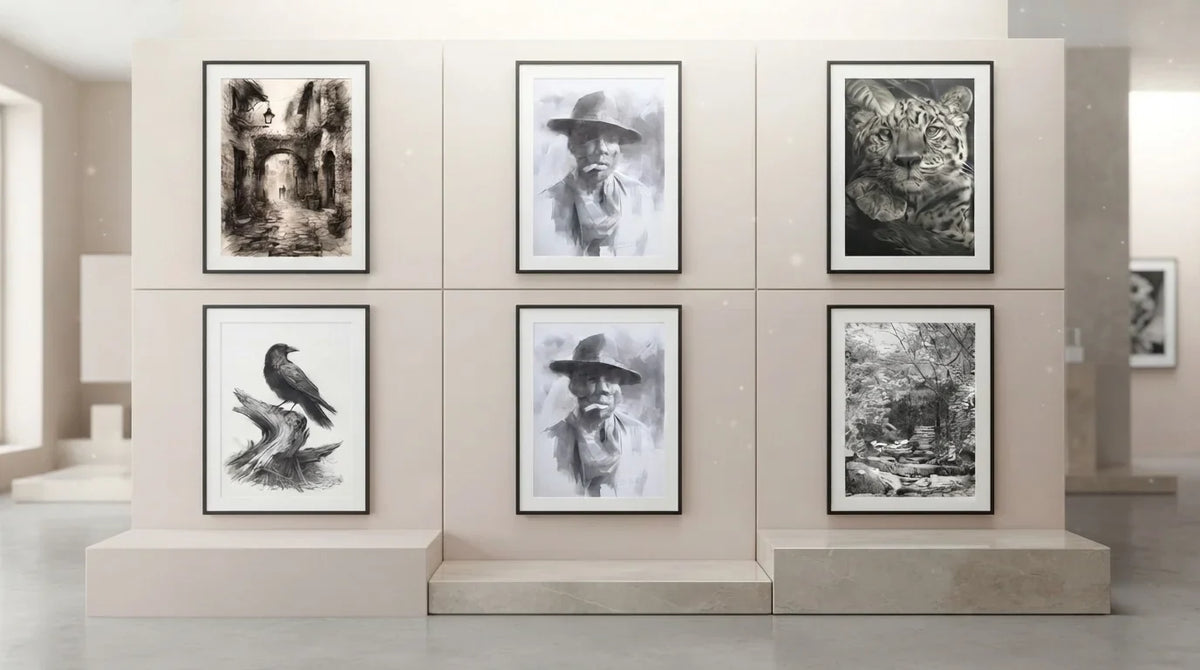
A perfectly drawn eye in graphite can appear more alive than a photograph. The special quality of light in a horse’s eye, the particular texture of a bird’s feather, the gentle curve of a petal carefully shaded, all have a presence which mechanical reproduction rarely gives. What many don’t realize is that drawing’s realism doesn’t stop at human subjects, but becomes even more powerful when directed at animals and the natural world. This blog describes how portrait pencil art brings extraordinary life like detail to horses, birds, flowers and wider nature subjects and how these works sit in a home interior.
Why Realism Matters in Portrait Art Pencil Work
The essence of portrait art in pencil, in the realist tradition, is observation. The artist observes the subject closely, knows how light plays over a surface, how muscle lies beneath skin or fur, how texture varies over different parts of the same subject. It’s this kind of careful attention that distinguishes realist pencil work from the looser, more conceptual approaches.
This ability to observe is what gives the viewer an emotional connection when they see a real life pencil portrait. If the detail is correct and the tonal range is perfectly handled, the viewer's brain responds as if it were something real. That is the response that realism seeks, and that is why so many collectors prefer finely rendered pencil work to more expressionistic approaches.
What Makes a Pencil Portrait Feel Realistic?
A pencil portrait is realistic when the artist can accurately capture the tonal gradation, surface texture and consistency of the light source. Realistic pencil work is about layering your shades, controlling the weight of your line and really observing anatomical proportion, so that the flat surface of paper appears to have a sense of three-dimensional form.
Capturing Horses Through Realistic Pencil Art
Horse pencil art is one of the most difficult subjects in the realist tradition. The horse's body combines large planes of muscle with intricate surface detail in the coat, mane, and face. To get the proportions right throughout the full form you need to have a good grasp of the anatomy of the animal without a live reference before you.
Pencil art of horses displays a certain type of artistic mastery that collectors recognise immediately. The way to shade for the definition of the muscles of the shoulder and the hindquarters is quite different from the technique for drawing each hair of the mane or the way light reflects on the coat. The two requirements must be met in the same drawing and this is what makes successful horse pencil portraits so impressive.
Detail areas artists focus on in horse pencil portraits:
- Accurate muscle tone and body proportion throughout the whole form
- Mane and coat texture created with layered directional strokes with varying pressure
- Eye detail that conveys expression, depth and the particular quality of the animal’s presence
- Light bouncing off the coat surface to give the illusion of roundness and physical depth
Bird Pencil Art and the Challenge of Fine Detail
Bird pencil art is considered by many to be the most technically challenging subject in the entire realist pencil tradition. It’s because of feathers. Each feather has its own structure, its own direction of growth, its own relation to the feathers around it. If you want to draw a wing successfully in pencil, you have to know that structure, and represent it accurately enough that the viewer’s eye reads it as real, not approximated.
Stillness in realistic bird portraits can capture motion as well. Even a drawing of a bird on a perch can express the alertness of the animal, the tension ripe for flight, through the precise angle of the head, the grip of the feet on a branch, the set of the wings. Such detail comes through only when the artist has studied the subject carefully and rendered it with real accuracy.
Techniques used to capture feather texture and lightness in bird subjects:
- Strokes of fine layers in the direction of the natural growth of each group of feathers
- Manage tone carefully to separate lighter underside from darker upper feathers
- Leaving feather edges highlighted to show the reflective quality of bird plumage
- Apply graduated shading around the eye and beak to create depth in the face without overworking
Why Is Bird Pencil Art Considered Difficult to Master?
Bird pencil art is difficult, because feathers need to be structure correct as well as having very fine control. Each group must be in the right direction and in the right relationship in tonality to its neighbours. The facial features, especially the eye and beak, are small and demand a precision that larger subjects do not.
Pencil Flower Art and the Art of Soft Realism
Drawing animals is a different animal altogether and a different approach from pencil flower art in the realist tradition. Horses and birds demand the rigour of structure and proportion; flowers, the softening of them, and the suggestion of delicacy, not by sharp definition, but by restrained shading. A heavy line of pencil on a petal immediately destroys the feeling of transparency that makes floral pencil work believable.
Realistic floral pencil work has a quiet, contemplative quality that appeals. A drawing of roses or lilies with careful tonal gradation produces a sense of calm and natural beauty that painted versions of the same subject sometimes overstate. The restraint of the graphite medium is appropriate to botanical subjects in a way that is truly his own.
Technique focus points in pencil flower art:
- Soft gradient shading across petal surfaces to suggest transparent and natural light
- Observing carefully the natural curves of the way the petals curl and overlap one another
- Light and shadow are not sharply bounded but there is a slight tonal contrast between them
- Fine controlled linework for stems, leaf veins and the specific edges of botanical forms
Broader Nature Pencil Art Beyond Horses and Birds
As a category, nature pencil art is so much more than just individual animals and flowers. The same attention to close observation and truthful representation that marks the realist pencil portrait is brought to bear upon landscape elements, tree bark, rock surfaces, water, and scenes of wildlife in their natural habitat.
Nature rewards realism because it roots the viewer in something familiar. A tree that looks real with accurate surface texture and convincing light and shadow produces the same reaction as a realistically rendered animal portrait. The viewer knows what he is looking at, and reacts to the accuracy with the same kind of quiet appreciation that always meets skilled technical work.
Bringing Realistic Animal Pencil Art Into Your Home
Realist animal pencil art is particularly suitable for rooms where the space is used for close, attentive viewing. Animal portraits naturally fit in studies and home offices, as the detail in a finished animal portrait rewards the constant attention that a working or reading environment naturally encourages. Hallways are also a good placement location, as the near viewing distance of a corridor allows the viewer to see the fine detail that makes these works so impressive.
Placement is an important factor for the scale of realist pencil work. If a portrait of a horse is too small, it loses a great deal of its impact. The detail the artist has worked so hard on can’t be seen from a normal distance. In contrast, a large detailed piece on a wall that needs to be viewed from a distance play to the strengths of the work.
Placement ideas for animal and nature pencil portraits:
- Studies and home offices where sustained close attention reveals all the detail in the drawing
- Hallways where visitors can observe fine texture and shading at the close viewing distance
- Personal engagement with the work in an intimate setting through reading corners
- Above a desk or on a bookshelf, where the precision of the work corresponds to an interior thought
Expert Framing Art Gallery offers professional advice for framing detailed pencil work. They make sure each piece is glazed and displayed to protect the surface and enhance the viewing experience.
Final Thoughts
Portrait pencil art on animal and nature subjects achieves something that few other art forms do, so directly. The combination of close observation, technical skill and the quiet restraint of the graphite medium creates work that feels genuinely alive, despite being just a simple drawing. An eye of a horse rendered with emotional presence, a bird’s wing feather by feather, a flower petal shaded with careful gradation as these images surprise those who have underestimated what pencil work can do.
Realistic pencil portraits of animals and nature are a sophisticated and very personal art choice for collectors and homeowners in Karachi and all over Pakistan. Suitable for studies, reading rooms and hallways where the detail can be properly appreciated. Expert Framing Art Gallery is a trusted place to discover and frame these works with the care and quality of presentation they truly deserve.
Frequently Asked Questions
Q. What Is Portrait Pencil Art?
Portrait pencil art is artwork done in graphite or pencil with the specific purpose of capturing the likeness, character and presence of a subject through accurate rendering of proportion, texture and tonal gradation. It can just as well depict human subjects, animals or nature with the same depth and emotional impact.
Q. What Makes Horse Pencil Art Challenging to Create?
Horses have large muscular planes and a lot of fine detail in the coat, mane and face, which makes horse pencil art difficult. The artist needs to be able to make the anatomy believable throughout the whole form. At the same time, they need to be able to capture the fine detail of texture and expressiveness in the eyes and facial features.
Q. Why Do Artists Focus on Eyes in Animal Pencil Art?
The eyes are the emotional center of any animal pencil art portrait. The eye is so accurately rendered that one feels the subject is present and aware, not just represented. Most viewers react most strongly to the quality of light in the eye and the depth behind it when viewing realistic animal portraits.
Q. What Skills Are Needed for Bird Pencil Art?
Bird pencil art requires fine motor control, patience, and knowledge of feather structure and growth direction. The artist has to paint each group of feathers in relation to the neighbours, and maintain consistent tonal relationships over the whole surface, and capture the reflective quality of plumage.
Q. How Is Pencil Flower Art Different From Animal Pencil Art?
Pencil flower art is not an art of structural precision but softness and restraint. Petals need subtle gradient shading, natural curves, not hard definition. Animal portraits call for anatomical accuracy and expressive detail; floral work calls for tonal delicacy and the suggestion of light in natural plant forms.
Q. Can Nature Pencil Art Include Landscapes as Well as Animals?
Yes. Nature pencil art comprises landscapes, trees, rock surfaces, water, wildlife in habitat and also single animal or flower subjects. All these subjects have the same closeness of observation and accuracy of tonal rendering that is characteristic of realist pencil work in all subject categories.
Q. Where Should Realistic Pencil Art Be Displayed at Home?
Realistic portrait pencil art works are best viewed close up so are ideal for studies, halls and reading corners where they can be seen at close quarters. Don’t put these pieces on walls that will be viewed only from long distances, because the fine detail that makes them so impressive is lost when viewed from distances of more than a few feet.
Q. How Should Detailed Pencil Art of Horses Be Framed?
A mat board should be used to matt pencil art of horses to create visual breathing room between the art and the glass. Most pieces are best in a thin, clean frame of natural wood, black or dark metal that doesn't compete with the detail of the work. Museum quality glass protects the surface from UV and humidity damage.
Q. Does Portrait Pencil Art Suit Both Modern and Traditional Interiors?
Yes. Portrait pencil art is suitable for both modern and traditional interiors. It adds quiet depth and hand crafted character to modern settings. It goes naturally with heritage tones and classic furniture in traditional settings. The monochromatic quality of pencil work means it rarely conflicts with an existing interior palette.
Q. What Size Works Best for a Realistic Animal Pencil Portrait?
Generally, A3 to A2 size is quite suitable for a home display of a realistic animal pencil art portrait, especially for a single subject. Larger drawings make detail visible at comfortable viewing distances. Smaller pieces are well suited to hallways and intimate settings where the viewer can get close enough to appreciate the fine technical work.
Share:
Abstract Pencil and Charcoal Art: Modern Wall Styling Guide
Charcoal Painting on Canvas vs Pencil: Mediums & Framing