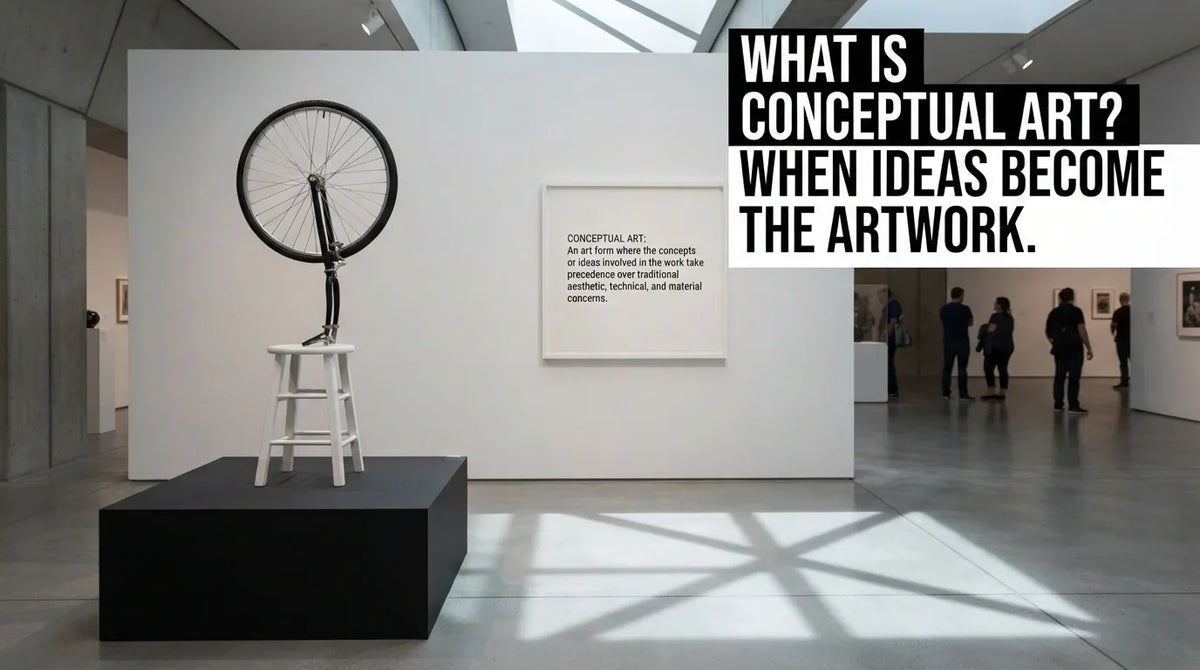
Art doesn’t always have to look like something familiar to belong in a gallery. Somewhere along the way, a shift happened where the idea of a piece became more important than the physical form. This is the world of conceptual art, and it can be confusing to viewers the first time they encounter it. Conceptual art is what happens when intention replaces craftsmanship, so a blank wall with some text on it, a photo of an everyday act, an object taken from everyday life can all be conceptual art. This guide explains what the movement is really about, where it came from, and how to understand it without an art history degree.
What Does Conceptual Art Mean?
Conceptual art is an art movement where the idea behind a work is more important than the work itself or the skill used to create it. The actual artwork is the artist’s plan, message or intention and the object is often just a piece of support, or sometimes not needed at all. This is the simplest way to understand conceptual art meaning is about without getting lost down in academic terms. Once you accept that an idea by itself can be art, the rest of the movement starts to make sense.
The Core Idea Behind Conceptual Art
The conceptual art definition is based on one governing principle: the idea becomes the artwork. Some pieces are just instructions, spoken words or a record of something that has already happened. If the physical object exists at all it is only proof that the idea did. This is very different from most art traditions where the finished piece is the point.
How Conceptual Art Differs From Traditional Fine Art
Traditional fine art aims to focus on skill, technique and visual appeal. A painter trains in brushwork for years, a sculptor trains to handle material with precision. The conceptual work inverts that priority. The artist's ability to draw or paint matters far less than the strength and clarity of the idea being communicated. A powerful idea can carry a rough sketch further than a technically perfect painting with nothing to say.
The Origins of the Conceptual Art Movement
The roots of the conceptual art movement go further back than most people think, long before the term was invented.
Marcel Duchamp and the Readymade
A long time before conceptual art had a name, Marcel Duchamp had planted the seed. He chose everyday manufactured objects and turned them into art by situating them in a gallery context. The performance challenged the basic assumption that art must be made by the artist’s hand. Duchamp's readymades got people asking a new question: does art have to be made, or can it simply be chosen and framed as meaningful?
The 1960s Breakthrough: Sol LeWitt and Joseph Kosuth
Formal conceptual art movement came into being in the 1960s. It is a kind of machine that produces the art,” Sol LeWitt said, “and the finished object is almost a byproduct. Joseph Kosuth went even further, and used his work to question what art actually is, basically, rather than how it looks. These artists provided the movement with a theoretical backbone upon which future generations built.
Why the Movement Gained Recognition
Critical writing, gallery shows, and a direct challenge to the visual focus of Minimalism and Modernism gave conceptual art credibility. With time, museums like MoMA and Tate began collecting and exhibiting conceptual work, thus giving the movement some institutional weight. Difficult ideas were translated into language that could be understood by more people, critics and curators. This recognition in time turned an unusual experiment into an accepted branch of contemporary art.
Core Characteristics of Conceptual Art
Certain characteristics keep showing up in conceptual art artworks, and being aware of them makes the style much easier to recognize.
Dematerialization of the Art Object
One of its features is dematerialization, a reduction of the importance of the piece's physical form. Some works are known only through photographs, written descriptions, or verbal accounts of an event. The object almost becomes optional; the concept can exist without it. This is one of the clearest conceptual art characteristics to look for if you try to identify the style.
Text-Based and Instruction-Based Art
In conceptual work, language itself is often the medium. Written instructions, printed statements or wall text can stand in for traditional visual pieces altogether. Artists like Lawrence Weiner have built entire bodies of work using nothing but text, proving that words can be as heavy as paint or stone. The method does not require any traditional craftsmanship of any kind.
Viewer Participation and Intellectual Engagement
Conceptual pieces usually leave their meaning open for the viewer to complete. The artist makes the idea, but the interpretation is inside the head of the person who is looking at it. This is a more active form of looking than the passive admiration of a landscape or portrait. Two people can walk away from the same conceptual piece with entirely different readings of it.
Different Types of Conceptual Art
The ideas behind this movement are expressed through a number of media, not only installations or performances.
Conceptual Painting
Conceptual painting sounds like a waste of time, because painting is usually associated with visual skill. But paint based work is conceptual when the system, process or idea behind it is more important than technique. So, when an artist repeats the same motif under changing rules, painting becomes a vehicle for an idea and not a display of talent. The brushwork becomes secondary to the logic driving the piece.
Conceptual Art Photography
Conceptual art photography aims to record ideas, performances or staged situations, rather than traditional beauty. There are times when a photograph is taken simply to record that something happened, the image itself being evidence, not art in the classical sense. It turns the camera into a means of documenting ideas instead of a device for capturing the scenery or portraits.
Installation and Performance-Based Concept Art
Some work of the imagination can't be done without space, time and an audience. Installation work may only be meaningful in a specific room, and performance work only in the moments of it taking place. These formats extend conceptual thinking from fixed objects to lived experience.
Famous Conceptual Artworks and What They Teach Us
The most obvious place to start with some examples of conceptual art is still Marcel Duchamp’s Fountain of 1917. Duchamp made an ordinary object into art by concept alone, showing that meaning could come from context and intention, not from craftsmanship.
Joseph Kosuth’s One and Three Chairs (1965) defines the principle of idea over object. The work features a real chair next to a photograph of the chair and a printed dictionary definition of the word chair, leaving the viewer to wonder which one is the real artwork.
Sol LeWitt’s writings on conceptual art laid out the movement's theoretical basis, defining the plan behind a work as the real creative act. Yoko Ono’s instruction-based works extended this logic into performance, showing how a single written prompt could generate a whole artistic experience, without the artist ever touching a final object.
Conceptual Art vs. Abstract Art vs. Traditional Art
These categories are often mixed, and teasing them apart helps readers navigate and search art with more confidence.
Where the Confusion Comes From
While abstract art doesn't show anything recognizable, it still focuses on visual form, composition, and color. Conceptual art can do without visual form altogether, for the idea does not always need a striking image to succeed. Most of the confusion begins here. This is where the appearance overlap happens, particularly with conceptual pieces that look abstract or minimal.
A Simple Way to Tell Them Apart
One quick mental test will tell which. Ask if the real work in the piece is the idea or the visual execution. If you take the visual part out, and you lose the meaning of the work, then it’s probably more traditional or abstract. If the meaning survives even without a striking image, the piece is functioning as conceptual art.
How to Read and Appreciate a Conceptual Artwork
Viewing a conceptual piece for the first time can be disorienting, but a few simple questions can make it much more rewarding. The way a gallery presents and contextualizes conceptual work, like that of Expert Framing Art Gallery, can also help viewers connect with pieces that might otherwise feel disconnected or confusing.
Questions to Ask When Viewing Conceptual Art
- What is the artist trying to communicate with this piece?
- Would the meaning change if the physical object looked different?
- What is my role simply by looking or interpreting this work?
- Do you need to add more text, documentation or instructions for this piece to work?
- What is the history or social context that influences the reception of this idea?
Final Thoughts on Conceptual Art
Conceptual art changed what art can be. It shifted the focus away from visual skill to intention, message and interpretation. The movement has always asked viewers to think, not to admire, from Duchamp's readymades to Kosuth's chairs. Recognizing its basic characteristics, from dematerialization to text-based work, makes even the strangest gallery pieces more approachable. The moment you start to wonder what idea a work is trying to express, conceptual art stops being confusing and starts to feel like a conversation between artist and viewer.
Frequently Asked Questions
Q. What is conceptual art?
It is an art movement in which the idea behind the work is more valuable than the piece itself. The idea is the artwork, and the object, if there is one, is secondary to the idea.
Q. How did conceptual art gain recognition?
The essential writing of the 1960s, key artists like Sol LeWitt and Joseph Kosuth, and eventual adoption by major institutions like MoMA and Tate gave the movement lasting credibility.
Q. What are the characteristics of conceptual art?
Common characteristics include the dematerialization of the physical object, mediums which are text or instructions and a large use of viewer interpretation for the completion of the work's meaning.
Q. What is the meaning of conceptual art?
It describes art that prefers intention and message to visual form or technical skill. The artist’s concept is considered the final product, regardless of the presence of a physical entity.
Q. What are the different types of conceptual art?
Types include conceptual painting, conceptual photography, text-based work, and installation or performance-based work, all of which use a different medium to present an underlying idea rather than a focus on visual technique.
Q. What defines conceptual art?
It is the artist’s intent that is key. Conceptual art is art where the idea behind the piece is what the piece is really about, not the look or craftsmanship.
Q. How is conceptual art different from abstract art?
Abstract art still depends on visual form, composition and color, even if not representational. Conceptual art can do away with visual form completely, because the idea can carry the entire meaning of the piece.
Q. Who founded the conceptual art movement?
The first seeds of the movement are usually attributed to Marcel Duchamp in his readymades, and in the 1960s Sol LeWitt and Joseph Kosuth gave the movement its theory and definition.
Q. What is an example of conceptual art?
Two famous examples often cited are Fountain by Marcel Duchamp, and One and Three Chairs by Joseph Kosuth. Both of these works are examples of how a concept can be the art work itself.
Q. Can conceptual art be a photograph?
Yes. Conceptual art photography is not about documenting traditional beauty but rather about recording ideas, performances or staged scenarios. The camera is therefore used as a tool for documenting concepts not scenery.
Q. Is conceptual art still relevant today?
It remains very relevant today, with its emphasis on ideas over objects still influencing contemporary and digital art practice where work based on concepts is often considered more important than traditional visual technique.
Share:
Surrealism Art: Understanding Its Meaning, History and Style