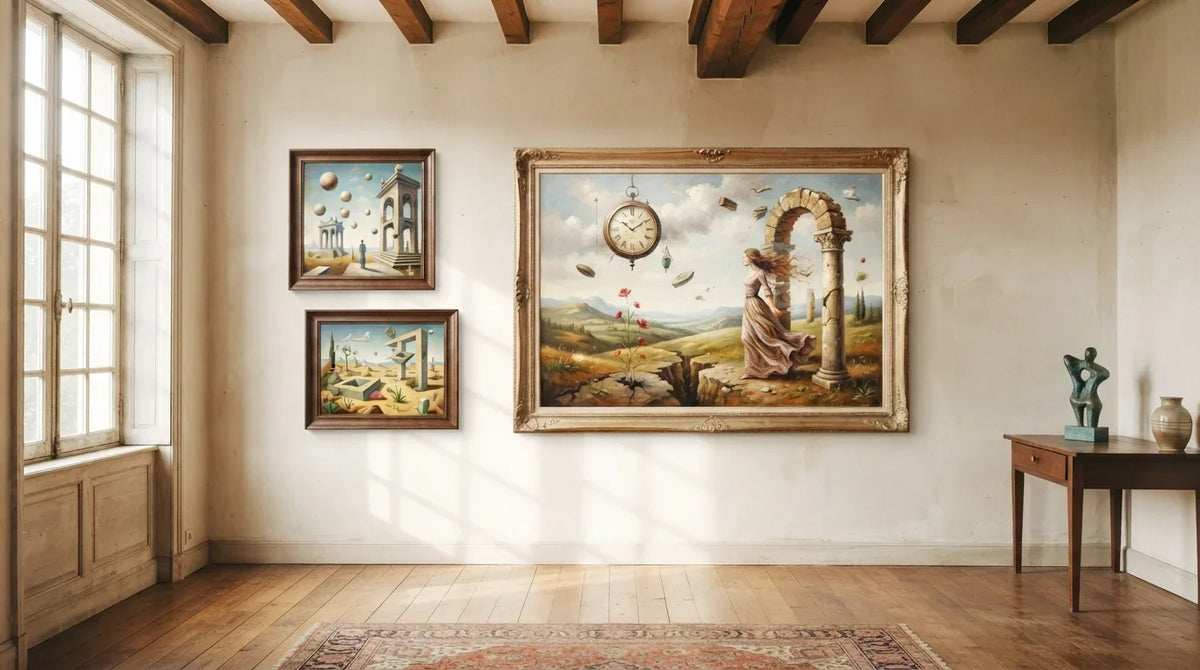
Some paintings won't follow the laws of the visible world. Clocks break over edges of tables. Figures in empty sky drift. A bowler hat turns into a face. Surrealism art uses the logic of dreams directly onto the canvas, producing images that seem impossible but strangely familiar. A lot of people look at surrealist works, and get drawn in, without knowing why. In this blog we’ll take a look at what Surrealism means as a movement, where it came from, its visual and conceptual qualities, techniques used by artists and why its influence has never really faded.
What Is Surrealism Art?
Surrealism art is an art movement that began in the early twentieth century and was an attempt to unlock the creative potential of the unconscious mind. Surrealist artists created images that bypassed conscious logic, using dreams, memories and irrational associations instead of representing the world we can see. The result is art that feels like a waking dream, familiar in its parts but impossible in its combinations.
The surrealism art definition is a genre of art and literature founded on the belief that the rational thought suppresses the human experience. By appealing directly to the unconscious, artists could reveal truths that the waking, logical mind could not reach. Surrealism art meaning is not simply about being strange. The movement was not interested in the bizarre for the sake of the bizarre. It was interested in what is beneath the surface of ordinary experience.
What Is Surrealism Art?
Surrealism art is an early 20th century movement that used dreamlike imagery, unconscious associations and irrational comparisons of familiar objects to reveal deeper psychological truths. The surrealist artists did not try to depict observable reality but explore the subconscious levels of the human mind through visual and literary representation.
The Origins and History of the Surrealist Movement
Surrealism art history begins in Paris in the early 1920s. In 1924, André Breton published the first Surrealist Manifesto, formally defining the movement and its principles. Breton was greatly influenced by the theories of the unconscious developed by Sigmund Freud and the importance of dreams as windows into repressed ideas and desires.
The movement had its origins directly in Dada, a previous artistic movement that rejected conventional art, and accepted craziness, in response to the trauma of the First World War. Dada rejected logic. Surrealism took that and built a more structured philosophical base. As political conditions in Europe declined in the late 1930s, many surrealist artists fled to America, spreading the movement’s ideas into more broad visual culture.
Key Characteristics of Surrealism Art
Surrealism art characteristics are recognisable once you understand what the movement was trying to do. These paintings are not trying to represent the world as it looks like. They show the world as it might look in a dream, when rational control relaxes.
Main features of core surrealism art are:
- Unexpected combinations of familiar objects in impossible relationships
- Strange shapes and proportions that are not found in the real world
- Dream-like environments that are familiar but naturally incorrect
- Powerful symbolic images with psychological or emotional meaning
- Technical accuracy to make the impossible appear very believable
What Are the 7 Characteristics of Surrealist Art?
They are: combinations of unexpected objects, distorted or impossible forms, dreamlike settings, strong symbolic content, irrational relationships of space, psychological depth below the surface of the visual, and technical precision to render the impossible scenes with convincing realism.
Common Themes and Symbols in Surrealist Art
In surrealism art paintings there are some symbols that often appear that have come to be associated with specific meanings. The melting clocks represent the fluidity of time in dreams, where time is warped past the fixed measurements of the waking world. Mirrors are symbols of identity and the gap between surface appearance and hidden reality.
Freudian ideas about the natural dimension of human psychology, which rational society represses, are appealed to in hybrid figures that combine human and animal features. A dreamlike feeling of being weightless, of floating or objects that appear to rise, is common in many surrealist compositions. The symbols mean a great deal and were chosen as much by conscious association as by design.
Different Styles and Approaches in Surrealism
Surrealism art is not one visual style. The movement developed two major lines of thought.
Veristic surrealism is realistic, highly detailed imagery of impossible scenes painted with photographic precision, drawing on qualities associated with Realism art. It's not from loose technique, but from the combinations presented that give the dreamlike quality. This is the mode in which both Dalí and Magritte worked, using precise academic technique to make the impossible appear obviously real.
Automatic or Abstract Surrealism is natural, and the artists work fast or use techniques that introduce chance into the process. The result is more abstract and less readable at first glance.
What Are the Two Main Types of Surrealist Art?
There are two basic types of surrealist art: veristic and automatic. Veristic surrealism uses exact realistic technique to portray dreamlike or impossible scenes. Automatic surrealism is more spontaneous, less controlled, allowing the unconscious to directly influence the work, often leading to more abstract results.
Abstract Surrealism and Surreal Landscape Art
Abstract surrealism art is between total abstraction and representational surrealism. Artists working in this mode frequently retain recognizable elements within compositions, but treat them in a way that affects any clear reading. Forms run into one another. Figures suggest bodies without quite displaying them.
Surreal landscape art, surreal landscape painting and some of the most striking work in the tradition. Dalí’s landscapes are recognizable as desert plains or coastal environments but at the same time violate everything that makes those environments physically logical. Surreal landscape painting is based on familiar visual frameworks, which it systematically blurs throughout, so that its images are disorienting in the sense that the basic structure appears almost right.
Techniques Used by Surrealist Artists
The surrealist painters developed specific ways to access the unconscious and to lower the conscious control in the making process. It is drawing or writing without conscious direction. The hand moves freely and the image forms without planning. It was central to both the painters and literary art branches of the movement.
Frottage is when you take a textured surface, and cover it with paper and rub pencil over it. Random patterns can inspire imagery. Decalcomania is an art process of spreading paint between two surfaces and then separating them to produce random organic shapes. Each technique is an opening to chance, which the artist interprets and develops into a finished composition.
Major Surrealist Artists and Their Contributions
Several artists defined the surrealism painting tradition:
- Salvador Dalí brought incredible technical accuracy to impossible images, creating some of the most famous surrealism art paintings in history
- René Magritte in his quiet, matter-of-fact compositions questioned the relationship between images and what they represent
- Max Ernst was a pioneer of technical innovations in surrealist work such as frottage and collage
- Joan Miró approach became more abstract and playful, using biomorphic shapes and automatic drawing
- Frida Kahlo expanded the surrealist palette to include very personal psychological and cultural symbolism
Surrealism Art Examples
For most viewers, the most recognizable surrealism art examples are Dalí’s “The Persistence of Memory,” from 1931, with its melting clocks over a barren landscape. The painting uses photographic realism to render a physically impossible scene easily believable and then uses that belief to question assumptions about time and reality.
Magritte’s “The Treachery of Images” shows a painted pipe with the caption “This is not a pipe.” The work directly addresses the gap between representation and reality, a core concern of the movement. Buyers of surreal and surreal-inspired art often remark on the value of institutions such as Expert Framing Art Gallery in providing curatorial and framing expertise with these visually complex works.
The Influence of Surrealism on Contemporary Art
The surrealism art genre did not end with the formal dissolution of the movement in the mid-twentieth century. Its ideas and visual strategies still inspire artists, designers, filmmakers and photographers. Contemporary practice has absorbed and further developed a willingness to mix unexpected elements, the treatment of the dreamlike as a legitimate subject, and the drawing on psychological experience as artistic content.
You can trace their lineage in the work of many contemporary installation artists, digital-media artists and figurative painters. The movement’s belief that the unconscious contained material to be expressed visually remains a productive point of entry for artists who are doubtful of purely rational or observational approaches to image-making.
Frequently Asked Questions
Q. What Is Surrealism Art?
Surrealism art is an early twentieth century movement, founded in 1924, that used dreamlike imagery and unconscious associations to create works that go beyond visible reality. Surrealist artists used Freudian psychoanalysis to access the psychological material that rational thinking usually hides in painting and literature.
Q. What Defines Surrealism Art?
Surrealism is an art form in which the unconscious mind is essential , in which dreamlike and illogical images are used, and in which familiar objects are set in impossible contexts. This is not just a weird image; this is a serious philosophical statement about what human experience is and what rational thought cannot do.
Q. What Are the 7 Characteristics of Surrealist Art?
The seven characteristics are: unexpected combinations of objects, distorted or impossible shapes, dreamlike settings, strong symbolic content, irrational spatial relationships, psychological depth below the surface visual, and technical precision in the realistic rendering of impossible images.
Q. What Are the Two Main Types of Surrealist Art?
There are two main types of surrealism. True surrealism uses realistic technique to depict impossible scenes. Automatic surrealism uses natural markings to allow unconscious visuals to develop. They share the same philosophical foundation, but produce different visual outcomes.
Q. When Did the Surrealist Movement Begin?
The surrealism art movement was officially founded in 1924 with the publication of the first Surrealist Manifesto by André Breton in Paris. Developed from Dada and heavily influenced by Freudian psychoanalysis, it attracted painters, writers and film-makers throughout Europe in the 1920s and 1930s.
Q. Who Are the Most Famous Surrealist Artists?
Salvador Dalí, René Magritte, Max Ernst, Joan Miró and Frida Kahlo are the most famous artists. Each had their own approach to shared concepts of dreams and the unconscious, which together formed the outline of what surrealism art paintings look like throughout the history of the movement.
Q. What Is the Difference Between Surrealism and Abstract Art?
Surrealism uses imagery associated with dreams and unconscious psychological content, even when it appears abstract. Abstract art moves toward pure form and color relationships, without reference to subject matter. Even the most abstract surrealism art still has an association with human experience and psychological meaning.
Q. What Techniques Did Surrealist Artists Use?
Surrealist art techniques include automatism, or drawing without conscious direction; frottage, or making images from textured surfaces; and decalcomania, or unpredictable paint transfer. Each technique was intended to lower rational control and allow unconscious representations to have a direct impact on the creative process.
Q. What Do Common Symbols in Surrealist Art Mean?
Surrealism art has psychological relations with common symbols. Distorted time in dreams is what is called melting clocks. Mirrors are about identity, about self-perception. Hybrid figures, combining human and animal features, hint at hidden feelings. Floating objects create the surreal absence of weight that is disconnected from normal physical reality.
Q. Is Surreal Landscape Art Considered Part of Surrealism?
Surreal landscape art is an important part of the tradition. Familiar landscape settings were used by artists like Dalí as physical frameworks for representations of scenes that were physically impossible. The familiar conventions make the distortions more disorienting, and therefore more effective, than they would be in a completely invented setting.
Q. How Does Surrealism Influence Art Today?
Surrealism art still inspires contemporary practice in painting, digital art, film and design. But its central ideas about the creative value of the unconscious and the power of unexpected visual combinations remain useful starting points for artists exploring imagination, dreams and psychological experience in their work.
Final Thoughts
Surrealism art has lasted because it touched something very basic about how human minds function. Dreams, desires, fears and the irrational associations made by the mind when the limits of rational control are loosened are not historical curiosities. They are still a part of every human experience, and art that deals honestly with that material still seems relevant and affecting across the generations.
The movement allowed artists to treat the invisible dimensions of experience as legitimate subjects of art, and that freedom has never been taken away. Its visual legacy is everyplace, in contemporary painting, in film, in advertising. Expert Framing Art Gallery offers a starting point for art lovers in Pakistan to engage with surrealist work and its living descendants, through original works and expert presentation guidance.
Share:
What Is Contemporary Art? Meaning, Evolution & Influence
What Is Conceptual Art? When Ideas Become the Artwork