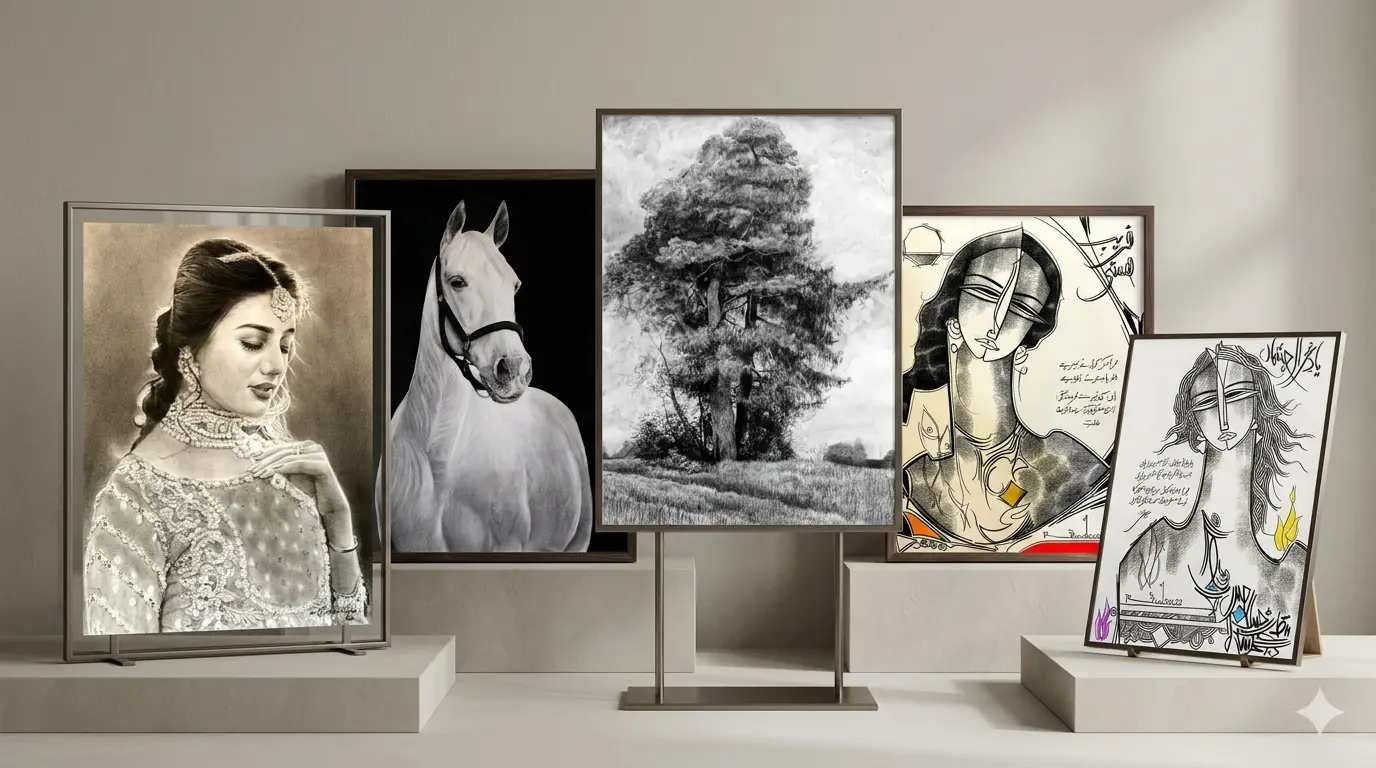

Some art requires your quiet attention. Charcoal is not one of those. Charcoal paintings have an instant appeal. The rich blacks, the soft gradients, the raw energy that feels like it is right there on the surface. But for all that boldness, charcoal has a familiarity that few media can rival. It has been used by artists for thousands of years and is still one of the most expressive tools available today. In this blog, we explore the visual appeal of charcoal paintings, how the medium translates across styles and why these works remain a draw for collectors and interior design enthusiasts alike.
What Is Charcoal Painting and What Makes It Unique
Charcoal painting sits at an interesting crossroads between drawing and painting. It uses burnt organic material applied directly to a surface to build tone, texture, and form. The difference is in the range it offers: The artist can move from the lightest whisper of grey to the deepest, richest black within the same composition, all through pressure, blending, and a good eraser.
The medium is also more forgiving than most during the creation process. This freedom is one of the reasons why charcoal painting produces work that feels alive and natural even when the final result is highly refined.
What Is Charcoal in Art?
Charcoal in art refers to a material made from organic matter burned at high temperatures in a low-oxygen environment. This gives you a soft, carbon rich stick that lays down marks from subtle grey traces to velvety black depending on how you use it.
Artists have used charcoal since ancient times, making it one of the oldest creative tools known to humans. It’s great for everything from roughing out ideas in loose sketches to nailing down details with precise strokes. It covers large areas fast, blends smoothly, and erases easily.
What Are the Three Types of Charcoal Art?
There are 3 main types of charcoal that artists work with and each has different qualities:
- Vine charcoal is the softest and lightest type of charcoal, made from burnt grape vines. Washes out easily and is good for basic sketching and loose compositional work.
- Compressed charcoal is thicker and darker because it is made from charcoal powder mixed with a glue-like substance. It makes very dark blacks and is hard to erase, so it’s best for bold, strong artwork.
- Charcoal pencils contain compressed charcoal in wood for the fine detail and precision of a pencil, which you can’t get with loose sticks.
The difference between an average charcoal work and an outstanding one is knowing which type suits a particular intention.
Charcoal Art and Its Long History in Fine Art
Charcoal art has one of the longest histories of all art forms. Charcoal marks are visible in cave paintings dating back tens of thousands of years, probably humanity’s first tool for the making of images. By the Renaissance charcoal was a standard preparing tool for painters and sculptors. By the 19th century charcoal art was no longer just an initial stage, artists viewed charcoal drawings as finished works to be framed and collected.
What Famous Artist Used Charcoal?
Charcoal has been used often by many famous artists. Edgar Degas used it to freeze the movement of ballet dancers in a way that paint alone could not. Like many of his ideas, Georges Seurat developed his impressionist ideas, in part through charcoal-related drawings. He built atmosphere tone with careful markings. Käthe Kollwitz created some of the most emotionally powerful charcoal work in the history of art, her drawings of human suffering a weight that speaks to the unique capacity of this medium for raw expression.
What Are the Most Famous Charcoal Paintings in Art History?
Famous charcoal paintings include Degas’s studies of the dancer, which with incredible conviction express form and motion. Masterpieces of the medium are Kollwitz’s figurative series on grief and motherhood. Some of Leonardo’s charcoal studies, which are works in their own right, show how the medium can be used for beauty as well as precision. These works suggest that famous charcoal paintings are forceful in their own right, not as initials to something else.
Charcoal Artwork and the Power of Contrast
The main visual characteristic of charcoal art is contrast. The charm of charcoal compositions is in the contrast between the blacks which are so dark and the brightness of the paper or canvas that is not touched. Negative space plays a major role too. In charcoal artwork, what the artist leaves unmarked is as important as what is marked, and the tension between the two creates depth and purpose in guiding the viewer’s eye.
How Charcoal Creates Depth and Dimension in Artwork
3D Form in charcoal artwork uses a variety of techniques that work together to create three-dimensional form. Blending and smudging create soft edges and smooth tonal transitions that suggest volume. Hatching builds more structured tone in areas that need to feel solid in texture.
Maybe the most underrated of all techniques is erasing. A good eraser doesn’t just erase mistakes. It also makes highlights and shows light sources in the composition. It’s this push and pull between application and removal that makes the best charcoal art feel effectively deep.
Charcoal Drawings and the Art of Expressive Mark-Making
Charcoal drawings have a clarity that is hard to find anywhere. When an artist makes a mark with charcoal, the gesture is visible in the result. The pressure, speed, and angle of the stroke all show up on the surface, giving charcoal drawings an energy that reflects the artist’s physical engagement with the work.
What Makes Charcoal Drawings So Expressive and Immediate?
Several physical properties of charcoal contribute to its expressive character:
- Instant response to pressure for subtle changes in tone
- It blends with the lightest touch, allowing smooth transitions between light and shadow
- It can be erased and can be worked over without harm to the quality of the surface
- Lay large areas of tone quickly, allowing artists freedom to work at pace
These qualities make charcoal drawings special because they can quickly show feelings, movements, and atmosphere, things that slower art forms don’t usually capture as fast.
Realistic Charcoal Drawing and the Mastery of Detail
At the other end of the expressive spectrum is realistic drawing in charcoal, where the focus is on accuracy, not gesture. It takes a lot of skill to get the real skin texture, fabric sheen or a real face from tonal values alone. No colour means that the artist must depend entirely on tonal relationships and the quality of the edge, and when done well, a realistic charcoal drawing can be really hard to differentiate from a photograph.
How Artists Achieve Photorealism With Charcoal
The process behind a realistic charcoal drawing typically involves careful layering. Artists begin with light vine charcoal to establish the composition, then build darker tones using compressed charcoal. Highlights are lifted with a working eraser, shaped to a point. Stumps are used to blend smooth tonal transitions in the areas of skin and fabric, and the fine detail that gives a realistic charcoal drawing its impressive finish.
Abstract Charcoal Art and the Bold Side of Expression
Abstract charcoal art takes the natural expression of the medium and pushes it to pure feeling. Instead of representation there are form, gesture, texture, and tonal contrast. The result can be very atmospheric, emotional and open to view in ways that realistic work is not.
Why Abstract Charcoal Art Works So Well in Modern Interiors
Abstract charcoal art is a natural fit for modern interior design. Its monochromatic design easily blends into spaces with neutral tones and minimal lines. The contrast of boldness and the gestural energy brings visual interest without adding colour that may compete with the scheme of the room as is. A large piece of abstract charcoal art can ground an entire space with sophistication and a real artistic presence, mostly in minimalist interiors.
Charcoal Landscape Paintings and the Drama of Nature
Charcoal landscape paintings have a weight of feeling. The medium is very well suited to natural environments, from stormy skies and misty valleys to rocky coastlines and deep forests. Without colour, their focus is mainly on atmosphere, and charcoal is one of the best mediums for atmosphere.
What Makes Charcoal Ideal for Capturing Landscapes?
Charcoal suits landscape subjects for several specific reasons:
- Light, mixed application for haze and mist in the atmosphere
- Strong tonal contrast naturally produces deep textured clouds in violent skies
- You can erase out to give a really bright effect with light breaking through clouds
- Open fields, still water and other large areas of tone can be set up quickly and clearly
These qualities are what make charcoal landscape paintings among the most visually powerful works in the medium.
Charcoal Painting on Canvas as a Bold Decor Statement
Charcoal painting on canvas creates a different visual experience than paper-based work. The texture of the canvas gives a tactile quality to the marks, the scale that canvas allows, transforms charcoal into something really impressive. Applying fixes at certain points along the way seriously expands the tonal depth possible, and a finished charcoal painting on canvas has a richness that can be similar to oil painting in terms of visual weight.
How to Display Charcoal Painting on Canvas in Your Home
Choice of frame matters a lot. A thin black or dark wood frame naturally complements the monochromatic palette. Ornate frames can also be used with more classic compositions. Wall placement should give the piece room to breathe. A single large charcoal painting on canvas on a neutral wall with good directional lighting is almost always the most effective approach, allowing the tonal contrast to do its work without visual competition.
Do People Buy Charcoal Drawings and Are They Worth Collecting
Yes, and more constantly than most people are aware of. The art market is very much into charcoal drawings by talented artists. Collectors like their realism, their technical depth, and the sense of contact with the artist’s hand and intention. Original charcoal drawings carry the energy of their making in a way that reproductions simply cannot replicate.
Are Charcoal Drawings Worth Anything as an Investment?
Original charcoal drawings hold real value, and the factors that influence worth include:
- The skill and reputation of the artist
- The size and scope of the composition
- The condition of the work and quality of framing and fixing
- The subject matter and its appeal to collectors
Emerging artist work with good technical ability can appreciate a lot over time. The trick is to buy original work of real quality, not reproductions or prints.
Frequently Asked Questions About Charcoal Paintings
Q. What Is Charcoal Painting?
Charcoal painting is the art of using charcoal to create tonal compositions in black, white and grey on paper, canvas or board. The work is built up by layering, blending and erasing, rather than using liquid paint to create form and atmosphere. It can be loose and gestural or highly detailed.
Q. What Is Charcoal in Art?
Charcoal in art is a drawing material made from organic matter burned in low-oxygen conditions. It makes gentle, easy to blend marks that can be light grey or dark black. Artists have used it for thousands of years because it can do many things, can be erased, and ability to create rich tonal depth quickly.
Q. What Are the Three Types of Charcoal Art?
The three main types are vine charcoal, which is soft and easily erased; compressed charcoal, which produces deep blacks and suits finished work; and charcoal pencils, which allow precise detail work. Each type of approach works well in various phases of the artistic process and various style methods.
Q. Do People Buy Charcoal Drawings?
Yes. Buyers prefer to collect charcoal drawings for their simplicity and technical depth. Portrait studies, figure drawings, landscapes and abstract works are all pleasing to the eye of collectors. Talented artists’ original work has real commercial value, and can be found in galleries the world over.
Q. Are Charcoal Drawings Worth Anything?
Original charcoal drawings of quality are genuinely worth collecting. The value is determined by the artist’s skill, the range of the work, the condition and the subject matter. Good works on charcoal can fetch prices similar to paintings and, with the right artist reputation behind them, can appreciate meaningfully over time.
Q. What Famous Artist Used Charcoal?
Edgar Degas is one of the most famous artists who used charcoal to draw ballet dancers, showing their movement and elegance very quickly and clearly. Käthe Kollwitz also created hugely important charcoal artwork; her drawings of human suffering are among the most emotionally powerful works of art in history.
Q. What Are the Most Famous Charcoal Paintings?
Among the most celebrated are Degas’s dancer studies, Kollwitz’s figurative works dealing with grief, and Leonardo da Vinci’s preparatory studies which stand alone as masterworks. These famous charcoal paintings show the whole range of expression and technique of which the medium is capable.
Q. How Is Charcoal Different From Pencil Drawing?
Charcoal makes wider, softer marks that blend much more easily than pencil. It is fast across large areas of tone and gives much deeper blacks. Charcoal drawings are likely to be more atmospheric and gestural. Pencil work is typically more precise and linear, with a narrower overall tonal range.
Q. Can Charcoal Art Be Used as Home Decor?
Yes. Charcoal paintings on canvas and framed charcoal paintings are a sophisticated decor choice that will fit many interiors. Its neutral color palette fits naturally into both minimal and traditional spaces. Charcoal art is a really impressive and memorable statement in any room when presented well and lit properly.
Q. What Surfaces Can Charcoal Be Used On?
Charcoal artwork can be created on paper, canvas, board, and various textured surfaces. Charcoal works best on paper with natural tooth. Canvas provides a unique grain and works well at a larger scale. The choice of surface has a great deal to do with the lay of the charcoal and the reading of the finished drawing.
Q. Is Charcoal Art Suitable for Pakistani Homes and Interiors?
Charcoal paintings look great in many Pakistani interior styles. Their simple black and white colors match both modern and traditional interiors easily. Expert Framing Art Gallery has a special collection of original charcoal paintings that fit local preferences and home designs.
Q. Where Can I Find Quality Charcoal Paintings in Pakistan?
For collectors and decor enthusiasts in Pakistan, can find the best original and framed charcoal paintings at Expert Framing Art Gallery. Their collection includes a variety of styles and sizes, making it an excellent place to start for anyone wanting to bring the bold presence of charcoal art into their home.
Final Thoughts
Charcoal paintings hold a special place in the art world. They are bold, but not loud. Expressive, but not lost in the plot. Technically demanding, but deeply personal. If you are looking for the accuracy of an accurate charcoal drawing, the mood of charcoal landscape paintings, or the energy of abstract charcoal art, there is something really compelling about the medium. For Pakistan’s collectors and home decor enthusiasts, charcoal art is an elegant and everlasting choice. Expert Framing Art Gallery continues to be a trusted source for those looking to bring the intense depth of charcoal paintings into their homes and collections.