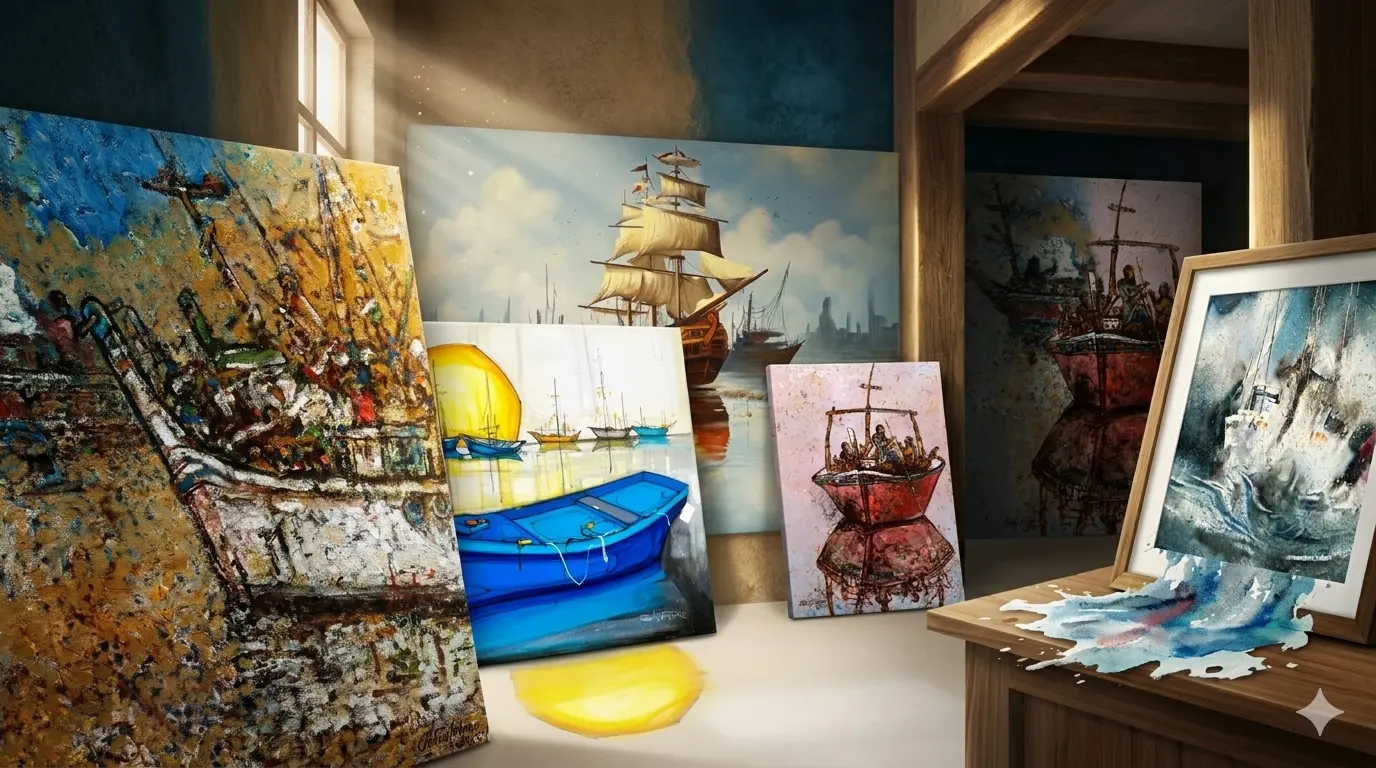

There is something deeply human about standing near water and feeling drawn toward the horizon. Artists have often tried to capture that feeling and one of the best methods to do so is with boat paintings. Whether it’s a quiet fishing vessel at rest in still waters or a tall ship battling an open storm, maritime art speaks to something universal. In this blog we look at why boat paintings have been so popular across cultures, how different mediums and styles affect the subject, and why they still have such a strong place in homes and collections today.
The Enduring Appeal of Boat Paintings in Visual Art
Boat paintings have themes that seem relevant in every age. Ideas of journey, solitude, freedom and the raw power of nature are ideas that never go out of the style. Water is always expressive in itself. It can be quiet and meditative or wild and unpredictable. When a boat is placed within that setting, it becomes a symbol of the human spirit navigating something far larger than itself.
This is part of the reason why maritime art has survived every major change in artistic styles. Most people react quickly to the emotional vocabulary of boat paintings; you don’t need any formal art knowledge to feel it.
Why Do Boat Paintings Feel So Emotionally Resonant?
Boat paintings awaken feelings that other genres sometimes miss. Nostalgia is one of them. Even for someone who has never lived near the sea, there is often a sense of longing attached to water scenes. The horizon suggests something just beyond reach, and boats represent the act of moving toward it.
A stormy seascape can bring a sense of urgency and drama. A calm harbour scene can feel like a slow exhale. This emotional range is one reason boat paintings appeal to such a wide audience across very different backgrounds and tastes.
Boat Art Through the Lens of Art History
Boat art has a long and well-documented history. In the 17th century, Dutch Golden Age painters made the marine subject a serious discipline, and produced compositions of remarkable technical precision. As art movements evolved the way the subject was treated also changed. The Impressionists were much more free, preferring light and atmosphere to accuracy.
By the time modernism arrived, some artists were reducing vessels to pure form and colour entirely.
How Boat Art Has Evolved From Classical to Contemporary
The shift from classical to contemporary boat art is essentially a shift in priority. Early maritime painters were often called upon to do record work. Their job was to be right. As photography took on that role in time, painters were freed to consider feeling instead.
The freedom is fully reflected in contemporary boat art. Loose expressionistic brushwork will hang next to photorealistic canvases, and abstract interpretations will share gallery walls with traditional oils. The subject has remained constant while the approaches have become far more varied and personal.
Ship Paintings and the Drama of Maritime Art
Ship paintings have always stood out in maritime art. Boats usually feel smaller and more personal, while ships often look bigger and stronger. Large sailing ships and old naval vessels also carry a deep sense of history. That is one reason many collectors enjoy ship paintings so much. They do more than cover an empty wall. They help a space feel more interesting and alive.
What Sets Ship Paintings Apart From Other Marine Art?
Ship paintings are different from other maritime subjects in terms of scale and narrative depth. A small boat painting might tell a quiet story of one fisherman. A ship painting often tells the story of empires, exploration, and forces that shaped entire civilisations.
Ship paintings are also a bit more demanding for an artist. It takes real technical confidence to deal with the relationship between a big ship, a dynamic sky and an active sea. The best examples balance all three with remarkable skill.
Ship Art and Its Place in Cultural and Naval History
Ship art has always served two roles at once. It is both artistic expression and historical record. For centuries before photography, ship art was the primary way naval battles, voyages of discovery, and trade expeditions were documented visually.
The genre carries a weight of cultural memory that few other art forms can claim. Owning a piece of ship art is, in a quiet way, owning a fragment of that broader record.
Why Ship Art Continues to Captivate Collectors Today
The collector appeal of ship art comes from several qualities working together:
- Historical depth that gives these works meaning beyond their visual surface
- Technical sophistication that hints at genuine artistic accomplishment
- Strong visual impact in both traditional and contemporary interior settings
- Cultural relevance, as the sea speaks to collectors from all walks of life
These qualities combined make ship art a consistently rewarding area of the maritime genre to collect.
Paintings of Boats on Water and the Poetry of Reflection
Few things in visual art are as immediately beautiful as light reflecting on water. Paintings of boats on water bring this quality to the centre of the composition. The ship and its reflection have a relationship that creates a visual rhythm that leads the eye naturally to it and holds it there.
Artists working in this tradition understand that the water is never passive. Even in calm scenes, ripples, shadows, and shifting light make the surface one of the most difficult and rewarding subjects a painter can tackle.
How Artists Capture Light and Reflection in Water Scenes
In paintings of boats on water, it is light that separates the normal from the extraordinary. Skilled artists study how light breaks across a surface at different times of day, how reflections distort under movement, and how colour shifts near the horizon.
Oil paint has long been preferred for this because of its blending capacity. Acrylic can achieve similar results through different techniques. In both cases, the goal is to make the viewer feel the light rather than simply observe it from a distance.
Paintings of Ships at Sea and the Art of Open Water
Paintings of ships at sea are on a different scale to harbour or river scenes. Open water compositions set the vessel against a vast and often turbulent background. The best pieces of work use sky and water together to create an atmosphere, storm clouds mirroring the movement of the waves below, or a pale horizon making a ship seem wonderfully distant.
What Makes Open Sea Compositions So Visually Powerful?
In paintings of ships at sea, several compositional elements create their dramatic impact:
- Little ship in a great and indifferent sea
- Stormy skies and cresting waves that build real tension
- Impressive lighting that shifts mood from heroic to vulnerable
- Provide the viewer a feel for the vastness of open water by scaling relationships
These elements, when handled with skill, give open sea paintings an emotional charge that remains powerful regardless of their age.
Boat Oil Painting and Acrylic Boat Painting Compared
Boat oil painting is a very traditional art form and for good reason. Oil paint lets you take time to blend, it has the brightness for darker tones, it can be worked over and over as the composition progresses. Water is never one colour or one texture and oil can deal with that complexity with a flexibility that few mediums can match.
Acrylic boat painting has earned serious ground in recent decades. You can push colours further, make contrasts more striking and the faster drying time is good for artists working in modern styles. Some artists use acrylics to build textured surfaces that give maritime compositions an almost three-dimensional quality.
Both mediums have genuine strengths. Oil suits atmospheric realism and traditional maritime subjects. Acrylic brings vibrancy and freshness that fits contemporary approaches beautifully.
Abstract Boat Paintings and the Expressive Side of Maritime Art
Abstract paintings of boats are in essence different. “They don’t try and document how the boats look, they try and document how they feel.” Precision in rendering is replaced by shape, colour, gesture and movement. The effect is usually surprising successful at communicating the essence of the sea without the sea being literally present.
Why Abstract Boat Art Works in Contemporary Interiors
Abstract boat paintings have a natural affinity with modern and minimalist interiors. They bring maritime energy and visual movement without the formality of traditional realism. A bold abstract composition with blues, greens, and whites can evoke the sea while also functioning as striking contemporary art.
For collectors who want the spirit of maritime art without usual representation, abstract boat paintings offer exactly that balance.
Boat Paintings on Canvas as a Timeless Interior Choice
Boat paintings on canvas remain the most popular format for maritime art in home and office settings. Paintings on canvas have a presence that prints and reproductions just can’t match. The texture, depth, and scale of a canvas work transform a wall in a way that feels permanent and considered.
How to Display Boat Paintings on Canvas in Your Home
Choosing the right size is the most important decision. The overall rule for the artwork is that it should be about 2/3 of the width of the wall space. Boat paintings on canvas that are 24 x 36 to 36 x 48 work quite well most of the time on the living room.
The framing also makes a huge difference. Traditional oil compositions look good in ornate, darker frames. Simple floater frames or unframed edges work well with abstract and contemporary works. Good directional lighting will make canvas paintings come alive in the space and enhance their texture and depth.
Frequently Asked Questions About Boat Paintings
Q. What Are Boat Paintings Called in Fine Art?
Boat paintings are part of the larger category of maritime art, also known as marine art or nautical art. This genre covers all paintings representing water, vessels and coastal or open sea settings. Subcategories are harbour scenes, naval paintings and seascapes.
Q. What Is the Difference Between Boat Art and Ship Art?
Boat art is usually smaller, more personal boats like fishing boats or sailboats. Ship art is about bigger ships of historical importance like tall ships or naval warships. That difference has effects on scale, mood and the kind of story the work tells visually.
Q. What Medium Is Best for Painting Boats?
Both boat oil painting and acrylic boat painting have real strengths. Oil suits atmospheric depth and traditional realism. Acrylic works better for bolder, more contemporary styles. The right choice depends on the artist’s approach and the mood the composition is trying to achieve.
Q. What Do Boats Symbolise in Art?
Boats commonly represent journey, transition, and freedom in art across cultures. They can symbolise solitude, the desire to explore the unknown, or the human relationship with forces beyond our control. In some traditions, a boat also represents the soul’s passage through life.
Q. Are Abstract Boat Paintings Suitable for Modern Homes?
Yes. Abstract paintings of boats are perfect for a modern, minimal interior. They provide visual interest without the formality of traditional nautical styles. Choose color palettes that complement your existing décor and compositions that feel balanced but not rigid.
Q. What Makes Ship Paintings Valuable to Collectors?
The value of ship paintings is determined by their historical meaning, quality of technical execution, medium quality, condition and their source. Usually, works presenting particular naval or maritime events are of special interest to collectors for their visual strength.
Q. How Do Paintings of Ships at Sea Differ From Harbour Scenes?
Paintings of ships at sea show big, exciting scenes with lots of space and movement. Harbour scenes are calmer and more personal, showing everyday life by the water. Both are valued in this genre, but the open sea compositions usually feel more powerful and emotional charge.
Q. What Are Some Famous Boat and Ship Paintings in Art History?
Turner’s The Fighting Temeraire is among the most celebrated paintings of ships at sea ever created. Winslow Homer’s seascapes capture open water with remarkable energy. Monet’s boat series brought Impressionist light to maritime subjects in a way that still feels fresh today.
Q. Where Can I Find Quality Boat Paintings in Pakistan?
For collectors and art enthusiasts in Pakistan, Expert Framing Art Gallery is a trusted destination for quality boat paintings and ship paintings, offering a carefully curated selection suited to both serious collectors and those looking for meaningful art for their interiors.
Final Thoughts
Boat paintings have had a long life because they speak to something universal. Water, vessels and open horizons are images that appeal to emotions that matter across time and cultures. From the precise drama of classical ship paintings to the expressive freedom of abstract boat paintings, the genre contains genuine depth and variety. Whether you are building a collection or simply looking to bring calm and character to a living space, maritime art offers something lasting. In Pakistan, where appreciation for fine art continues to grow, Expert Framing Art Gallery remains a trusted starting point for anyone ready to bring the timeless beauty of boat paintings on canvas into their home.